
The と / や (to / ya) Particles
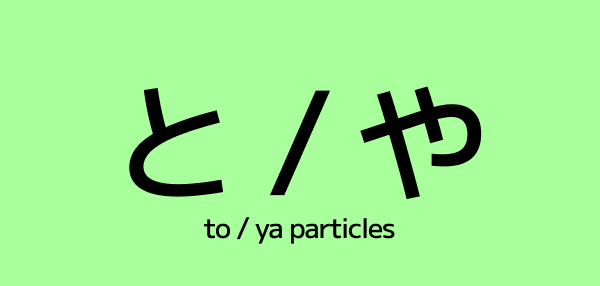
The particles 「と」 and 「や」 both serve to connect words, especially when listing items. However, their nuance and usage have a slight but important difference. Here, we'll break down how and when to use each one, with plenty of real-world examples and common pitfalls to watch out for.
1. What Do「と」and「や」Mean?
- と = “and” (complete, specific list)
- や = “and / such as” (incomplete list or examples of things in the list)
Both typically appear between nouns.
2. Using「と」for Specific, Exhaustive Lists
「と」connects all items in a list, implying nothing is left out.
Example:
りんごとバナナをたべました。 Ringo to banana wo tabemashita. (I ate an apple and a banana.) → Only those two.
Multiple items:
ねこといぬととりがいます。 Neko to inu to tori ga imasu. (There’s a cat, a dog, and a bird.)
3. Using「や」for Incomplete Lists
「や」 gives a few representative examples, implying there are more.
Example:
りんごやバナナをたべました。 Ringo ya banana wo tabemashita. (I ate apples, bananas, and things like that.) → Other things might’ve been eaten too.
Multiple examples:
ほんやざっしやマンガをよみます。 Hon ya zasshi ya manga wo yomimasu. (I read books, magazines, manga, etc.)
4. Comparing「と」vs.「や」
パンとミルクをかいました。I bought bread and milk. (Just those two.)
パンやミルクをかいました。I bought things like bread and milk. (More than two.)
5. Other Uses of「と」
a) Quoting Speech, Thought, or Sound
It can also be used like quotation marks.
Speech: たなかさんは「こんにちは」といいました。 (Tanaka-san wa "konnichiwa" to iimashita.) Tanaka said, “Hello.”
Thoughts: かれは「むずかしい」とおもいました。 (Kare wa, "muzukashii" to omoimashita.) He thought, “This is hard.”
Sounds (onomatopoeia):
いぬがワンワンとほえました。 (Inu ga "wan wan" to hoemashita.) That dog barked, "woof woof."
b) Conditional/Simultaneous Action
This is a more advanced usage, often covered under conditional grammar: ボタンをおすとドアがあきます。 Press the button, and the door opens.
6. Other Uses of「や」
「や」 can also be followed by など to further emphasize “etc.” Example: すしやラーメンなどがすきです。 I like sushi, ramen, and so on.
7. Common Mistakes
❌ Mistake 1: Using「や」for only two specific items
Incorrect: やさいやくだものをたべました。 (If you meant to say you only ate veggies and fruits, this sounds like you ate more than that.)
✅ Better: やさいとくだものをたべました。 → Just two, no ambiguity.
❌ Mistake 2: Using「と」when implying examples
Incorrect: アニメとマンガがすきです。 (Might sound like you only like those.)
✅ Better: アニメやマンガがすきです。 → Suggests there are other similar interests too.
8. Bonus: Use with People and Actions
When you use 「と」 between a person and verb, it means “with.”
Example: ともだちとあそびました。 (Tomodachi to asobimashita.) I played with my friend.
Example: おかあさんといっしょ (Okaasan to issho) "With Mother" (this is a kid's TV show in Japan!)
❌ Note: Using「や」this way doesn’t work.「や」is strictly for listing things.
Related Grammar
 E Rank
The から / まで (kara / made) Particles
「から」 means "from" and 「まで」 means "until"—together, they express ranges in time, place, and more. This guide breaks down how to use them naturally and fluently.
 E Rank
~てください (Polite Requests in Japanese)
 E Rank
The も (Mo) Particle
The particle 「も」 in Japanese is your go-to for saying “also,” “too,” or “not even.”
 E Rank
The に (Ni) Particle
に marks time, direction, location, purpose, and more. Learn how it works—and where learners go wrong.